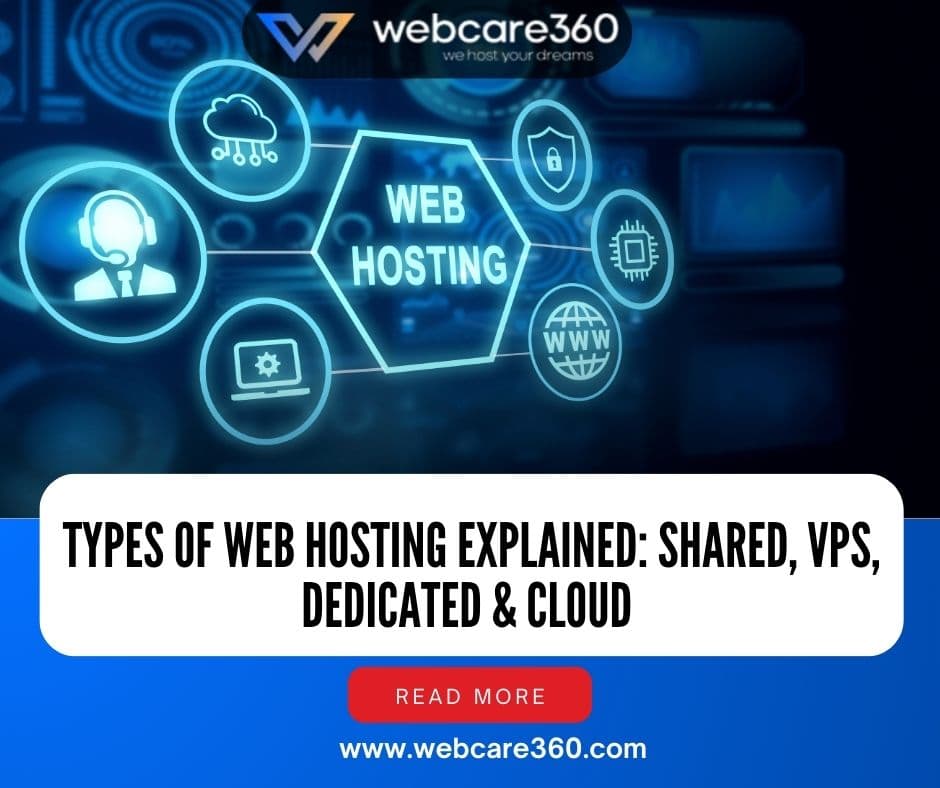
Shared hosting, VPS and dedicated servers describe different boundaries around hosting resources and customer control. Cloud describes a service model that can use virtual or dedicated resources. These labels help explain how a service is organized; they do not, by themselves, tell you its speed, security, management scope or availability.
This guide explains those boundaries. For the fundamentals of how a browser reaches a website, start with what web hosting is and how it works.
Shared hosting: an account within a managed platform
In a typical shared-hosting service, customers use separate accounts on a platform whose underlying resources also serve other customers. The provider normally controls the operating system and the hosting software; customers manage the capabilities exposed through their account. Application, process and resource limits depend on the product.
Multiple websites on one machine do not necessarily mean multiple virtual machines. For example, Apache virtual hosts allow one web server to serve multiple sites using names or IP addresses. Account isolation and resource enforcement are separate implementation questions.
The trade-off is less operating-system control in exchange for a narrower administration surface. Shared hosting is not inherently unsuitable for ecommerce or meaningful traffic, nor does the name establish a visitor ceiling. Performance depends on the application, allocations and how the platform manages competing demand.
VPS: a virtual environment with an allocation
A virtual private server gives a customer a virtual environment rather than exclusive use of an entire physical machine. Virtualization implementations differ. In full virtualization, an operating system runs on virtual hardware; NIST's full-virtualization guide describes this arrangement and its security considerations.
A VPS allocation can expose virtual CPUs, memory and storage, but the label alone does not establish whether CPU time is reserved, how storage is provisioned or which host resources remain shared. Isolation is not the same as a performance guarantee. Contention and security depend on implementation, configuration and operating practices.
Some VPS services grant extensive system access; others deliberately restrict it or include provider management. Root access, patching responsibility and available resizing operations must come from the service definition. A larger virtual allocation may require a restart or migration; the model does not promise unlimited or uninterrupted growth.
For the specific decision to remain on shared hosting or move to a VPS, use the shared-hosting versus VPS upgrade guide.
Dedicated servers: a physical-machine boundary
A dedicated server assigns a physical machine to one customer or service context. That changes the boundary around the machine's resources and may permit more control over its configuration. It does not imply exclusive use of every upstream network, storage service or facility dependency.
The physical allocation says nothing by itself about dedicated Internet bandwidth, DDoS protection, backups, operating-system management or an uptime commitment. A poorly configured dedicated server is not automatically safer or faster than a well-operated shared or virtual service.
Dedicated resources can also exist within a cloud service. Amazon EC2 Dedicated Hosts, for example, provide physical servers dedicated to a customer's use with host-level placement controls. That is an implementation example, not a description of every dedicated-server offer or a WebCare360 entitlement.
Changing physical capacity may involve hardware work, replacing a machine or moving a workload. The VPS versus dedicated comparison addresses the deeper two-model decision.
Cloud hosting: a service model, not a fourth performance tier
NIST defines cloud computing around on-demand access to pooled, configurable resources, including rapid provisioning and measured service. Its definition distinguishes service and deployment models. In commercial hosting, the word “cloud” still needs an actual service description: a virtual machine, a managed application platform and a replicated application service do not give the customer the same boundaries.
Provisioning more resources is different from making an application use them. A service may offer resizing or additional instances while the application still needs work to distribute traffic or data. Replication, health checks, failover and recovery are specific architectural capabilities; the cloud label does not prove that they are configured for a particular workload.
Measured service also does not mean every bill equals only the resources your application consumed. Billing units, minimum commitments, allocated capacity and separate services depend on the offer. Cloud is therefore not automatically cheaper, infinitely scalable or free of single points of failure.
Location is a separate property
“Offshore” describes a location relative to the customer, not another resource model. A shared account can also be offshore. First establish the account, virtual or physical resource boundary; then evaluate audience connectivity, data handling and the applicable service terms. A move across a border does not create root access or a larger allocation.
Management and recovery are separate dimensions
Resource ownership and operating responsibility are different questions. “Managed” must describe which tasks the provider performs and which remain with the customer. Application updates, data recovery and incident response cannot be inferred from shared, VPS, dedicated or cloud alone.
The same distinction applies to failures. An isolated environment, a reserved machine or a second instance does not establish a tested recovery process. Backups, restoration, redundancy and failover each need their own service or architectural definition. None of the four labels guarantees zero downtime.
As an illustration, a website can run in a virtual machine on dedicated cloud hardware while its database and backups use separate services. Calling the whole arrangement “cloud” leaves most of its operational boundaries unexplained. Identify the operator and recovery plan for each service in that arrangement.
Use the explanation to ask a more precise next question
The useful distinction is where a boundary sits: an account on a managed platform, a virtual environment, a physical machine, or a service abstraction. Control, operating duties and recovery capabilities then refine that description. There is no universal progression from a low-quality model to a high-quality one.
When you are ready to choose an actual configuration, the workload and hosting-plan selection guide covers requirements, operating responsibility, location, recurring cost and acceptance evidence. This article explains the models; that guide turns a real workload into a plan-selection brief.
WebCare360 publishes this educational guide as a hosting provider. It is not a comparative performance test. Current product descriptions and agreements, rather than this model overview, define individual service offers.