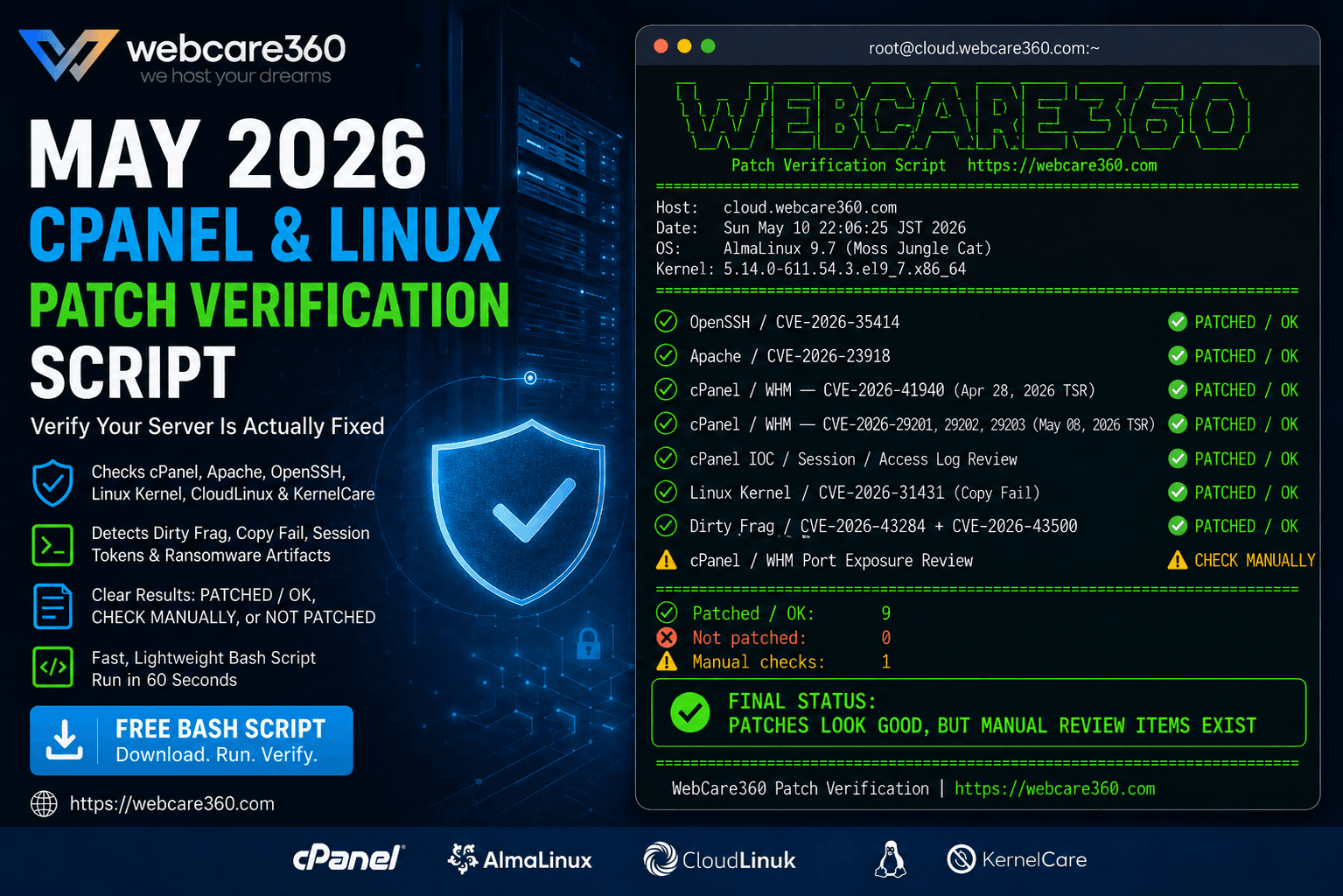
The WebCare360 May 2026 patch helper must not be used as proof that a server is patched or uncompromised. Review of its published source found checks that can report misleading results. This page explains those limits and the evidence an administrator should use instead; it does not recommend running the historical script.
Where the helper's results are insufficient
- Live patch coverage: a nonzero KernelCare patch level does not identify which CVEs are covered. The helper treats that value as proof of coverage for CVE-2026-43284. Verify the relevant patch against the running kernel and vendor's CVE-specific coverage.
- Update timestamps: an update log's modification time is not proof that a fixed build was installed successfully. The helper's May 2026 comparison also uses a timestamp for May 8, 2025.
- Module checks: a loaded module does not by itself prove an updated kernel is vulnerable. Conversely, a module being absent at one moment does not prove that an unpatched system cannot load it later.
- Port exposure: a local listening socket is not a test of reachability through host and upstream firewalls.
- Incident indicators: finding or not finding a filename pattern cannot establish either the exploit used or the absence of compromise.
These findings come from static inspection of the published helper on September 26, 2026. The script was not executed, and this review is not a complete security audit of that tool or any customer's server.
Verify the advisory, package and running state together
Start with the affected product, operating-system release and package source. Use the vendor's advisory for that exact branch; version strings from different distributions are not interchangeable because vendors may backport fixes.
For the May cPanel update, consult cPanel's branch-specific fixed builds. For Dirty Frag, follow the relevant operating-system vendor's advisory, such as AlmaLinux's patch notice. The cPanel guidance distinguishes kernel updates, live-patch verification and temporary mitigation.
Record the installed package, running kernel or service, applicable fixed build and any restart still required. A historical May baseline addresses named issues from that period; it does not establish that all subsequent vulnerabilities are resolved.
Keep remediation and incident response separate
If there are signs of unauthorized access, preserve evidence and follow the organization's incident-response process. Updating software does not establish that accounts, credentials or application data remain trustworthy. Coordinate disruptive changes and recovery with the administrator.
For a managed service, ask the support team to confirm the applicable scope and evidence for the specific system. This article makes no claim that every WebCare360 service has been inspected or patched.