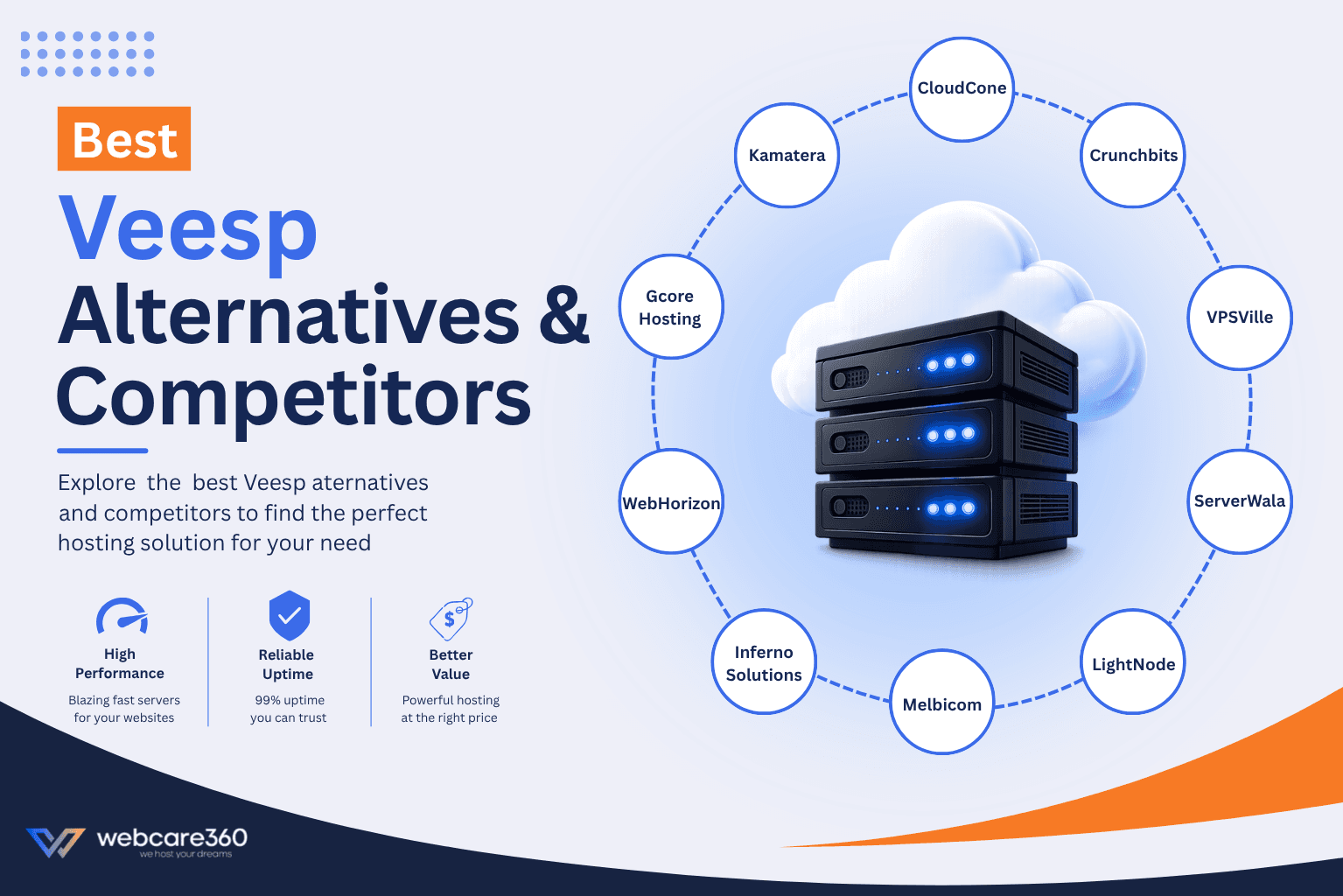
A Veesp alternative is useful only if it resolves a documented requirement. Start with the Veesp service you actually operate: its location, operating system, resource allocation, administration and recurring bill. This guide compares that baseline with CloudCone's SC2 cloud-server offer to show where the decision changes. It is a documentary comparison, not a performance test or ranked list.
WebCare360 publishes this article and sells hosting. No independent speed, support or uptime test is claimed. Provider descriptions below were checked on 28 September 2026; confirm the exact order and contract before purchasing.
Veesp already offers virtual servers and an API
The Veesp VPS page lists KVM virtual servers, NVMe storage, Latvia, Netherlands and Sweden locations, and an HTTP REST API. Its displayed plans offer several billing periods. Those features contradict a blanket claim that Veesp lacks virtual infrastructure or automation.
That page also contains an ambiguity worth resolving before migration: its feature list mentions customer ISO deployment, while its FAQ describes using rescue mode to write a cloud image rather than ordinary custom OS installation. Obtain the supported procedure for your particular image instead of assuming an installer workflow.
CloudCone SC2 changes the service comparison
CloudCone's SC2 page presents hourly resource pricing and lists Los Angeles for the displayed plans. It exposes resource changes, root access, backups and snapshots as product features. These statements do not establish that resizing is interruption-free, that every protection feature is included in a chosen order, or that SC2 is faster than Veesp.
CloudCone also offers a separately named VPS product. Record the exact product family when comparing quotations; an SC2 feature must not silently become an entitlement on a different VPS offer.
Build a like-for-like replacement record
| Decision | Evidence to record | Reason it matters |
|---|---|---|
| Location | Current Veesp region and candidate deployment region; representative user request timings | A move from Europe to Los Angeles changes the network path. A location count cannot predict application latency. |
| Billing | Same operating period, configured resources, addresses, backup charges and cancellation rules | An hourly headline and a prepaid monthly total are not directly comparable. |
| Images and access | Supported OS/image import, console, rescue and administrator access | A compatible CPU/RAM allocation does not establish a usable recovery procedure. |
| Operations | Written scope for updates, custom applications, backup restoration and incidents | Root access and a managed-service label answer different questions. |
| Automation | Required API actions and a safe test using a nonproduction instance | An API's existence does not prove equivalence with an existing deployment script. |
Test the actual reason for leaving
Write one acceptance condition before obtaining a candidate: for example, successful supported image restoration or an application response target measured from the intended audience. Use representative data with permission, identical application settings where possible, and repeatable observations. Record failed checks as well as successful ones. Do not infer support quality from an invented star score or a provider's customer-count claim.
Separate selection from migration
Once a candidate passes, inventory stateful data, DNS, certificates, scheduled jobs, credentials and external dependencies. Keep the current service until a tested cutover and rollback plan is ready. Neither a successful provisioning screen nor a cheaper estimate proves that moving is worthwhile.
The outcome should be a documented stay-or-move decision with a specific service, verified gaps and an operating-cost comparison. If Veesp still meets the requirement, retaining it is a valid result.
Test the reason for leaving with the slow VPS diagnostic checks.