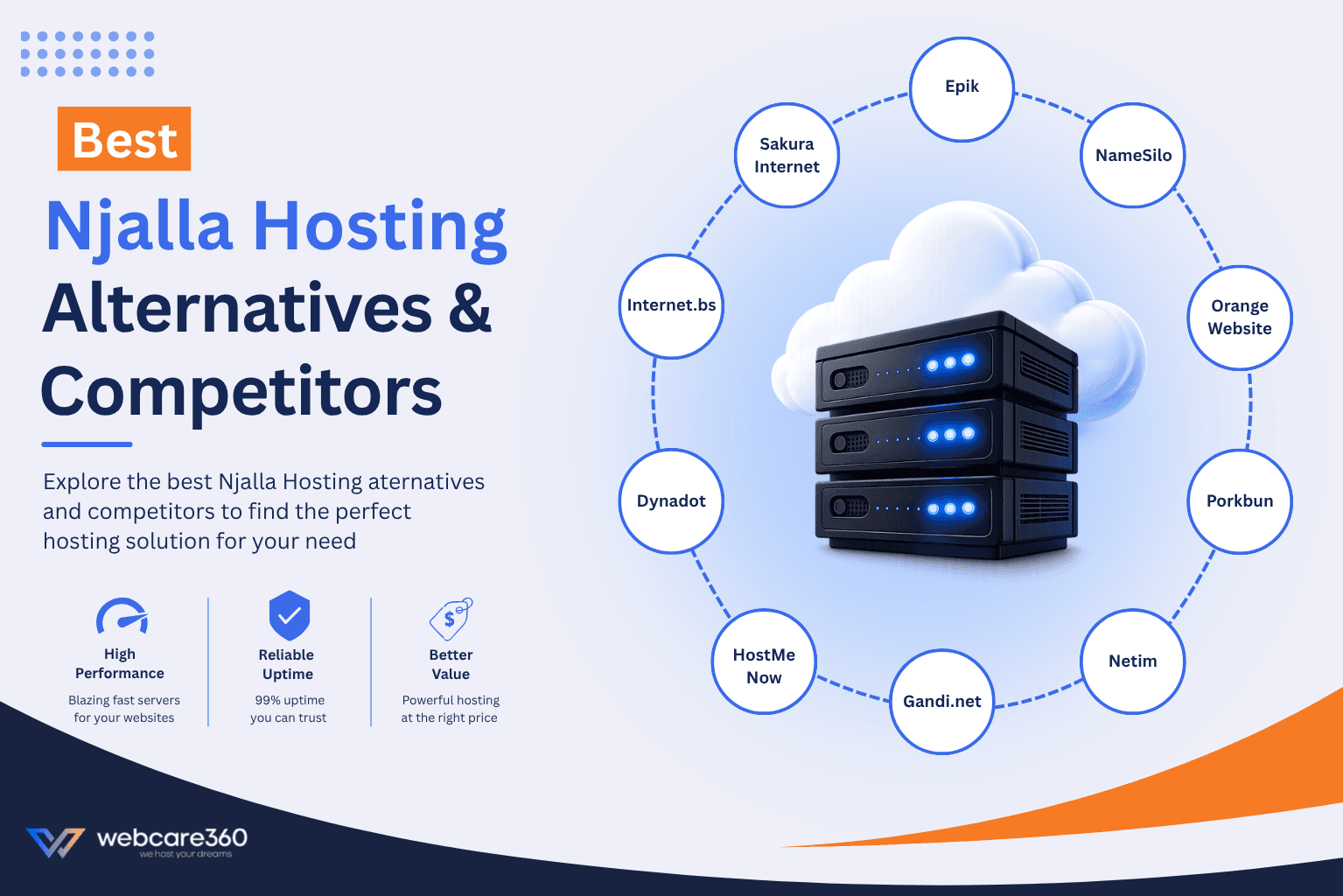
A Njalla alternative should be chosen by the service you want to replace: domain registration arrangements, DNS, a virtual server or a VPN. Moving a website does not necessarily require changing its domain provider. For a domain move, first decide who should be the registered holder and which privacy and transfer conditions you can accept.
WebCare360 publishes this guide and sells hosting. This is a document-based comparison, not an independent ranking or a report of performance tests. Official sources were checked on 27 September 2026; confirm the terms for your particular domain before acting.
Understand the ownership arrangement you are replacing
Njalla’s FAQ describes it as an intermediary between the customer and a domain registration service. It says Njalla owns the domain for the customer, grants usage rights by agreement and allows ownership to be transferred to the customer or another party. That arrangement is different from simply hiding contact details in a public registration lookup.
The current terms, section 3.3, distinguish Njalla being the registered holder from ownership in its relationship with the customer: the terms say that ownership vests in the customer. They also describe written acceptance of applicable agreements as a condition for formal transfer. Read these terms alongside the FAQ rather than treating its simplified wording as a complete legal description.
Obtain answers for the actual domain: who is the registered holder, who may authorize a transfer, what happens if account access is lost, and which conditions apply to suspension or termination? Do not treat an account dashboard as proof of the underlying registration relationship.
Neither model establishes complete anonymity. Account records, billing, support interactions and applicable disclosure obligations still need review. This guide does not assess your legal exposure or recommend a provider as safe for a sensitive personal situation.
Compare two documented registrar privacy approaches
These examples help identify what to ask; they are not a scored shortlist or a claim that either registrar is cheaper, faster or more private than Njalla.
- NameSilo: its privacy documentation describes replacing public contact details through PrivacyGuardian without changing domain ownership. The same page lists extension-specific restrictions. Check eligibility for your exact top-level domain rather than reading the general privacy promise as universal.
- Porkbun: its privacy product page describes a WHOIS privacy service. Verify the selected extension’s eligibility, the registration agreement, contact-forwarding behavior and the details that remain visible. A privacy feature alone does not answer ownership, recovery or transfer questions.
Record the actual registration, renewal and transfer quotation for each candidate in the same currency and term. Include optional privacy or DNS services and any tax shown at checkout. This comparison intentionally supplies no historical starting prices or unsupported “best value” verdict.
Create a domain-specific decision record
Use one row per domain, with the current answer, proposed answer, evidence date and unresolved issue. Complete these checks before selecting a replacement:
- Registration relationship: identify the registered holder, contracting party and authorized transfer contact.
- Privacy: record what the public lookup shows, what the provider retains and how inquiries reach you.
- Extension eligibility: confirm that the destination accepts the domain and the chosen privacy arrangement.
- Operational control: confirm access recovery, DNS editing/export, renewal settings and who can approve changes.
- Exit conditions: obtain the applicable transfer steps, lock/status information and any unresolved dispute or payment issue.
- Recurring cost: retain a dated quotation and the services it includes.
If the reason for leaving is support, specify the required channel and escalation process and request an answer. Do not infer responsiveness from a review score, a national location or the word “premium.” An unanswered requirement stays unresolved.
Separate transfer eligibility from a website cutover
ICANN’s registrant transfer FAQ distinguishes registrar transfers from changes of registrant and explains locks and authorization requirements. Confirm the rules for the actual extension and current status with the parties involved. Its general guidance does not establish that a particular Njalla-held domain is immediately transferable.
Do not change holder details, unlock a domain or request transfer credentials merely to experiment. First agree the sequence and timing with the current and receiving providers. Keep authorization codes private. A transfer should not be presented as a reversible performance test or a guaranteed zero-downtime action.
Inventory the authoritative DNS provider, current nameservers, mail records and other dependent services. Ask whether those services continue after the registration move. If DNS or hosting also needs to change, plan that work separately, preserve a recoverable configuration and validate essential website and mail functions. Record who can resolve a failed change before starting it.
Keep hosting and VPN decisions separate
Njalla lists domains, virtual servers and VPN services separately. A registrar with public-contact privacy is not automatically a replacement for a virtual server or VPN. If only hosting is unsuitable, evaluate application requirements, administrator responsibilities, export access and recovery while checking whether the existing domain arrangement can remain.
Use the migration requirements guide for a hosting move and the VPS privacy review for account and operational data questions. A current WebCare360 VPS offer describes hosting options; it is not evidence of a Njalla-style domain ownership service or anonymity guarantee.
Choose only after the differences are documented
Keep the current arrangement, move the domain, or change only hosting according to the verified gap. Save the accepted registration relationship, privacy conditions, transfer plan and unresolved limitations. If a critical ownership or access question remains unanswered, resolve it before transferring. The useful outcome is control you understand, not another provider’s position in a top-ten list.